Case Study
A Connected Ocean
Underwater Cellular Network Demonstrates the Future of Subsea Communications.
Overview
The need for seamless underwater communication is growing rapidly as the number of subsea assets increases. From autonomous underwater vehicles (AUVs) performing offshore inspections to divers conducting critical missions, continuous communication and tracking are essential for safety, efficiency, and mission success.
To address this, Subnero, in collaboration with ST Engineering Unmanned & Integrated Systems (ST UIS), have successfully deployed one of the world’s first underwater cellular networks in Singapore waters, demonstrating continuous coverage, seamless mobility, multi-user resource sharing, and real-time tracking of subsea assets. This deployment validates the architecture that will form the backbone of the Internet of the Oceans: the next frontier in global connectivity.
“Oceans cover 70% of the planet but remain 99% disconnected. Subnero’s mission is to change that — by building the Internet of the Oceans.”
Network Architecture
The need for seamless underwater communication is growing rapidly as the number of subsea assets increases. From autonomous underwater vehicles (AUVs) performing offshore inspections to divers conducting critical missions, continuous communication and tracking are essential for safety, efficiency, and mission success.
- A three-base-station network was deployed in Singapore waters.
- Underwater assets (e.g. AUVs) equipped with Subnero modems served as the mobile assets utilizing the network.
- A central network controller coordinated the system, enabling communication, handovers, and tracking.
This setup enabled continuous two-way communication between subsea assets, the AUVs and the topside controller, while also providing real-time location tracking whenever the vehicle was within range of three or more base stations.
Why Underwater Cellular Networks Matter?
- Supports multi-asset missions
- Enhanced operations; less downtime
- Enables autonomous subsea fleets
- Enhances safety for divers and vessels
- Unlocks persistent subsea IoT
- Scales like terrestrial networks: add more cells → expand coverage

Testbed Trials
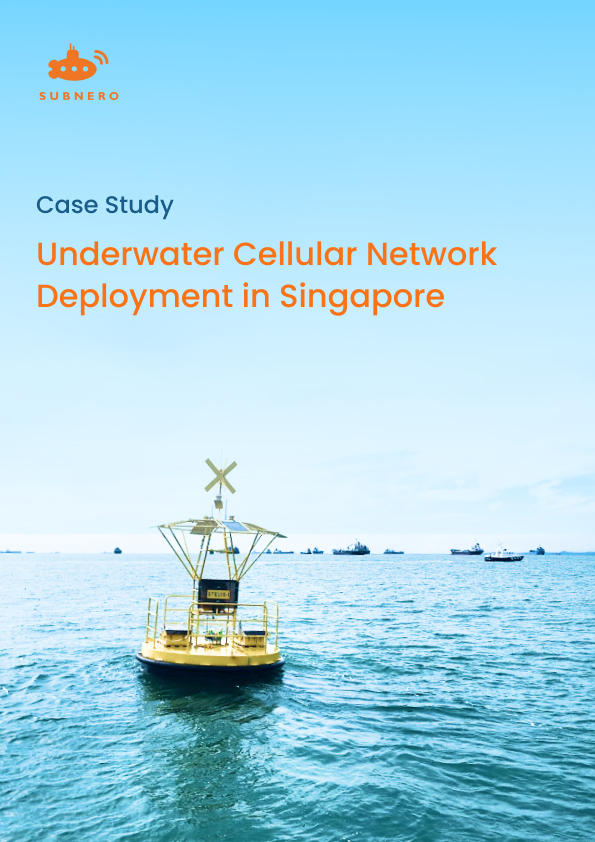
- A three-buoy underwater network testbed using Subnero modems was deployed to evaluate cellular-style subsea communication in real conditions.
- AUVs moved between coverage zones and demonstrated seamless handover, maintaining links to the controller.
- Both communication performance (packet transmission, command & control, telemetry) and localization accuracy were monitored.
- The tests were performed jointly by Subnero and ST UIS, demonstrating the system’s ability to maintain seamless connectivity and location awareness.
Key Takeaways
Continuous Communication
The testbed maintained stable communication across all trials, supporting uninterrupted data exchange as assets moved between base-station cells. It also demonstrated smooth handovers, much like mobile devices switching between cellular towers.
Continuous Tracking
The network delivered ongoing position updates of the subsea assets whenever coverage allowed, enabling consistent situational awareness throughout operations.
Scalability
The trial confirmed that by deploying additional base stations, the network could be scaled to cover much larger areas, opening new opportunities for subsea operations toward building the Internet of the Oceans.
Conclusion
This deployment clearly shows that underwater networks are now a reality, and can now behave like terrestrial ones. This is the beginning of a connected ocean: where AUVs, sensors, divers, and robots share one unified communication fabric, extending from the surface to the depths.
- Demonstrated that cellular principles can be adapted underwater, enabling continuous communication and tracking of subsea assets.
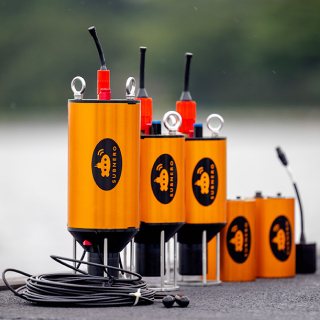
- Showcased a joint innovation between Subnero and ST UIS, leveraging acoustic modem technology and network intelligence.
- Paves the way for a new era of subsea operations, where AUVs, divers, and subsea sensors can remain connected at all times—supporting industries from offshore energy to defense and scientific research.
Perspectives
This collaboration has shown that cellular-style networks can bring real-world value to subsea operations. By validating the concept in Singapore’s demanding shallow-water conditions, we are opening the door to scalable solutions for defense, commercial, and research users alike.
Jay Poh Jin Jie
Vice President / Head Unmanned Systems Business Unit
ST Engineering

This deployment demonstrates our vision of making subsea communication networks as seamless and versatile as those on land. By enabling resource sharing and continuous connectivity, we are taking the first step toward building the 'Internet of the Oceans.'
Manu Ignatius
Subnero CEO