Unlocking the Power of Edge Processing with Subnero’s Coprocessor
In the world of underwater communications, Subnero’s acoustic modems have long been known for their robust performance. Out of the box, they already allow users to run their own logic directly on the device, extending standard communication features into a flexible platform for building novel subsea applications. Using Java-based UnetStack agents and Groovy scripts, users can implement custom behaviours, automate tasks, and develop intelligent underwater workflows—all without any additional hardware.
As underwater operations become more demanding, however, many emerging applications require more processing power than what built-in scripting alone can support. This is where Subnero’s optional coprocessor becomes valuable: a dedicated embedded computer designed for users who need greater computational capability, access to broader software ecosystems, or specialised processing such as machine learning.
When Do You Need a Coprocessor?
While many applications can be handled directly within the modem using built-in scripting, some users find themselves needing more compute, more flexibility, or the ability to use external toolchains and languages. This becomes especially important when applications demand real-time processing, advanced data handling, or when acoustic bandwidth is limited and it becomes more efficient to process data at the edge.
1. Acoustic Research with Custom Waveforms
For acoustic researchers, the ability to implement custom physical layer algorithms is often crucial. Subnero’s modems allow users to define arbitrary waveforms for transmission and reception. With the coprocessor, researchers can take this a step further and implement their own physical layer (PHY) and waveform strategies directly within the modem. Whether it’s testing new transmission protocols or experimenting with unique waveform detection methods, the coprocessor offers the flexibility to transform Subnero’s modem into a custom tool tailored to specific research needs.
2. Higher Layer Research (MAC, Link, Network, Transport)
In underwater communications, research doesn’t stop at the physical layer. Often, researchers and developers are looking to create and test algorithms for higher layers such as Media Access Control (MAC), link protocols, network management, or transport protocols. With the coprocessor, users can implement UnetStack agents directly into the modem, turning it into a fully-fledged subsea networking device. This enables the creation of an underwater “Internet,” where users can develop, test, and deploy new communication strategies using Subnero’s smart modems.
3. Data Processing at the Edge
In some applications, the need for efficient data transfer is paramount, but sending all collected data directly to the surface can be both costly and inefficient, especially when acoustic bandwidth is a precious resource. This is particularly true when dealing with large datasets from sensors like ADCPs, temperature, pressure, and other monitoring devices. Users can take advantage of the coprocessor to pre-process this data before transmission, reducing the need for high-bandwidth transmissions and conserving both power and acoustic bandwidth. This is crucial for long-term deployments where conserving resources is key.
How Does Subnero Achieve This?
Subnero’s coprocessor is a powerful computing unit housed within the same pressure-rated hull as the modem, forming a compact and integrated platform. It runs a full Linux environment, giving users the freedom to:
- develop in Python, C/C++, or any preferred language
- install third-party tools, libraries, or frameworks
- run GPU-accelerated workloads where supported
- access the system via secure shell (SSH) just like a standard Linux machine
Whether running machine learning models, advanced physical-layer algorithms, custom analytics pipelines, or specialised research tools, the coprocessor provides the computational headroom necessary for modern underwater applications.
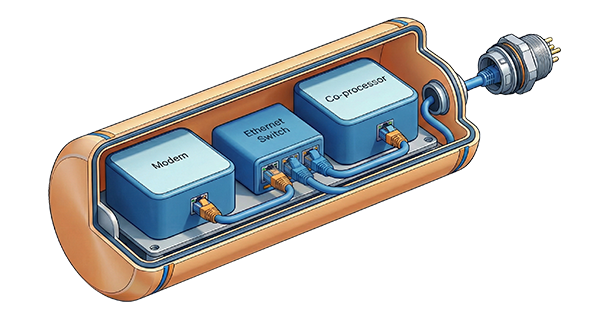 Subnero modem with a co-processor
Coprocessor for Machine Learning at the Edge
One of the most compelling applications of the coprocessor is its ability to run machine learning models at the edge. With the power of GPUs integrated into the coprocessor, researchers can implement real-time data analytics, enabling them to make decisions based on sensor data before it even reaches the surface. This is particularly useful in autonomous vehicles and underwater robotics, where onboard decision-making is essential for operational efficiency and safety.
Why Use a Coprocessor?
-
1. Reducing Latency: By performing edge processing, you can significantly reduce the time it takes to process and act on critical data, allowing for fast decision making in dynamic environments.
-
2. Conserving Bandwidth and Power: Sending processed data instead of raw data reduces the need for high-bandwidth communication, optimizing both power usage and the use of limited acoustic bandwidth.
-
3. Customization and Flexibility: The coprocessor transforms Subnero’s modems into highly customizable systems. Whether you need to implement your own transmission algorithms or create a fully integrated underwater communication network, the coprocessor gives you the flexibility to innovate.
-
4. Scalability: As your applications evolve, so too can the capabilities of your modem. The coprocessor can support a wide variety of applications, from simple data logging to complex real-time analytics, making it a versatile solution for many different use cases.
Learn More About the Coprocessor
If you’re interested in adding edge processing to your underwater communication system, Subnero’s coprocessor is available as an optional accessory for our modems. With this accessory, you gain access to the full power of the modem’s capabilities, including advanced processing, machine learning, and custom algorithm development, all within the robust and pressure-rated housing of Subnero’s acoustic modems.