For OEMs, Integrators, and Mission Owners
Underwater Networking, Out of the Box
A complete communication layer for your subsea assets, AUVs, sensors, and divers, built on a configurable network stack. Use the stack, mitigate the integration risk.
Reimagining Underwater Connectivity
The Challenge
Most teams entering underwater networking start by buying acoustic modems, then spend years building the protocol stack, routing, and network logic on top. The physics is unforgiving and the development cost is high.
The Solution
Subnero gives you the communication layer, not just the modem. The Subnero Underwater Network is a field proven stack you configure for your topology, your nodes, and your subsea application, and that same stack carries your data on to shore. You skip the hardest part of the build and go straight to deployment.
One Network for Everything Underwater
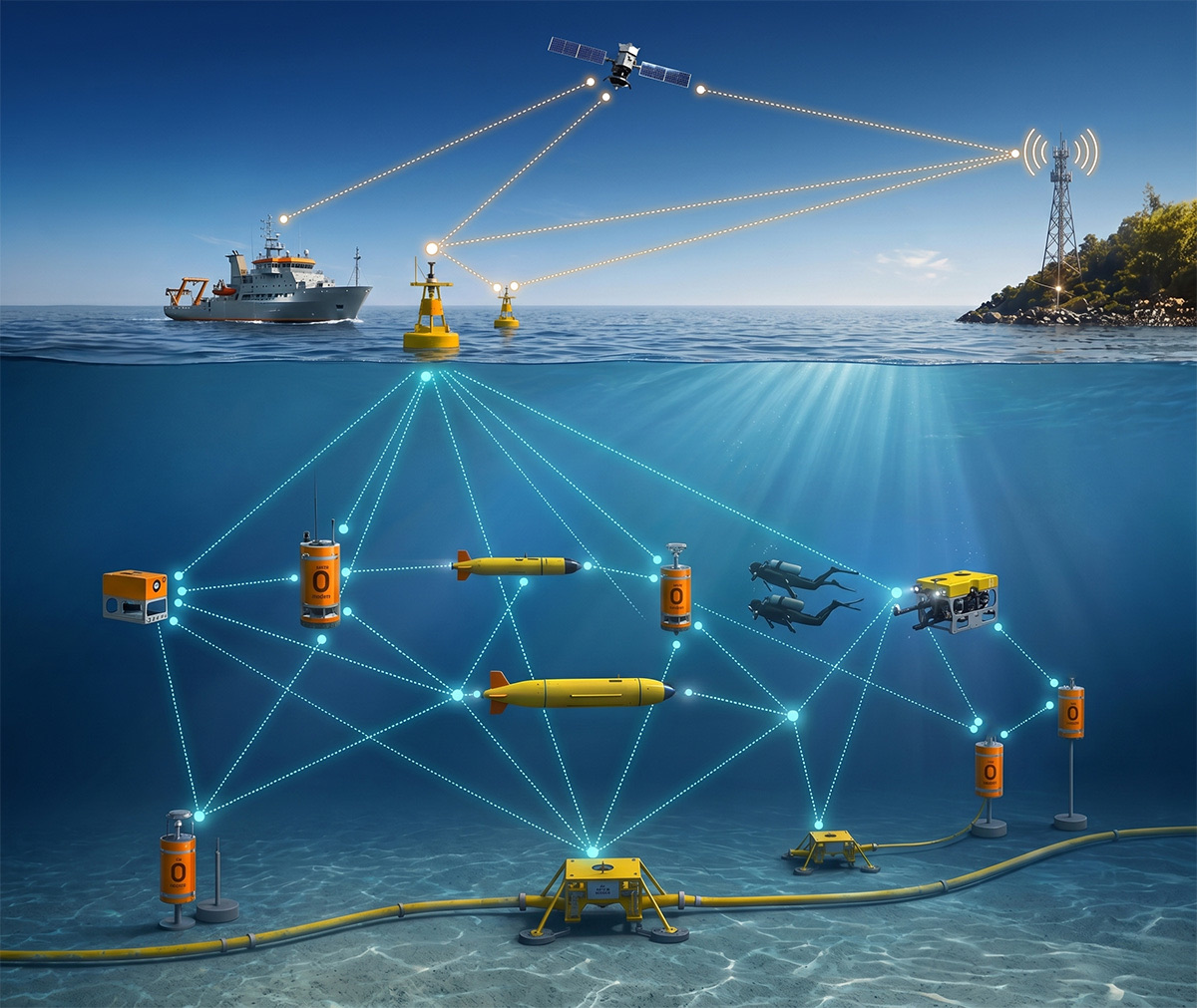
The Subnero Underwater Network, or SUN, is a complete communication layer connecting subsea assets to the surface, shore, and cloud. At its core is a software-defined network stack that coordinates communication across fixed, mobile and surface-connected assets. It runs on Subnero Acoustic Smart Modems over acoustic links underwater, optical links where higher bandwidth is available, and terrestrial links above the surface.
Underwater, SUN turns independent devices, autonomous vehicles, seabed sensors, landers, divers, gateway buoys, and vessels, into one coordinated network. The same technology scales from a single relay link to a wide area fabric of many nodes.
Who Connects to the Network
Marine Robots
Keep command, control, and telemetry live as the vehicle moves through the operating area, and relay payload data such as imagery back through the network.
Sensor Nodes
Landers and moorings that log continuously and deliver their data over the network to a topside or shore endpoint, without a vessel sitting on station.
Divers
Messaging and telemetry between divers and a supervisor who is not in direct range, with position awareness across the whole team.
Applications
01. Offshore Energy Asset Monitoring
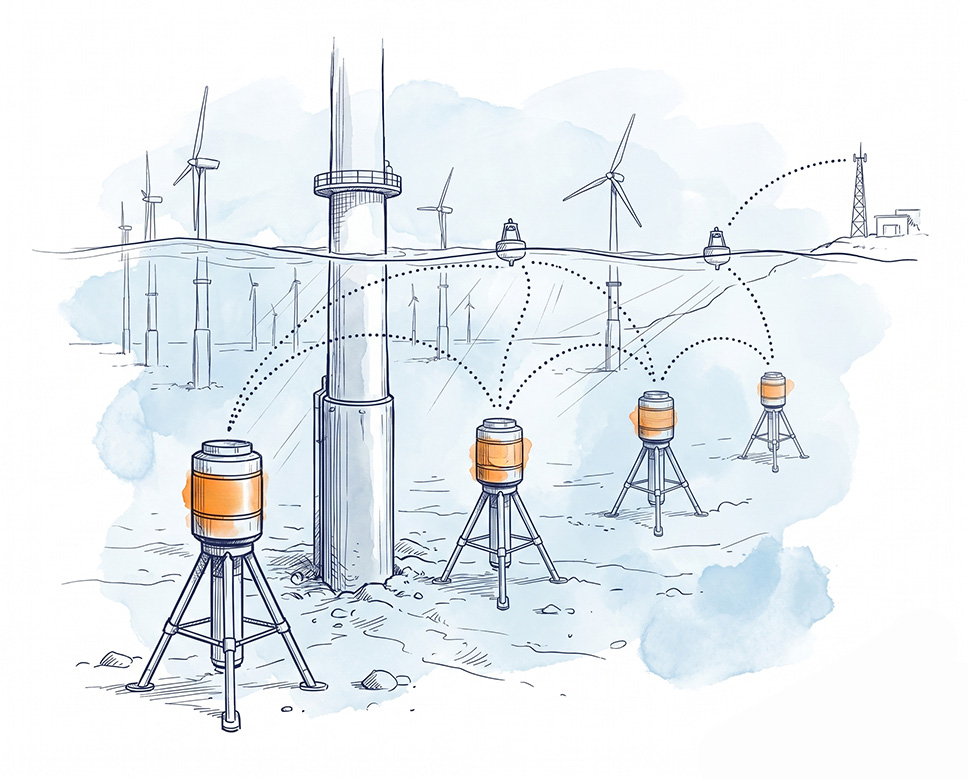
Pipelines, wellheads, and wind farm foundations report continuously over the network, with condition data delivered to shore without a vessel on station.
02. Acoustic Monitoring (PAM) for Marine Mammal Research
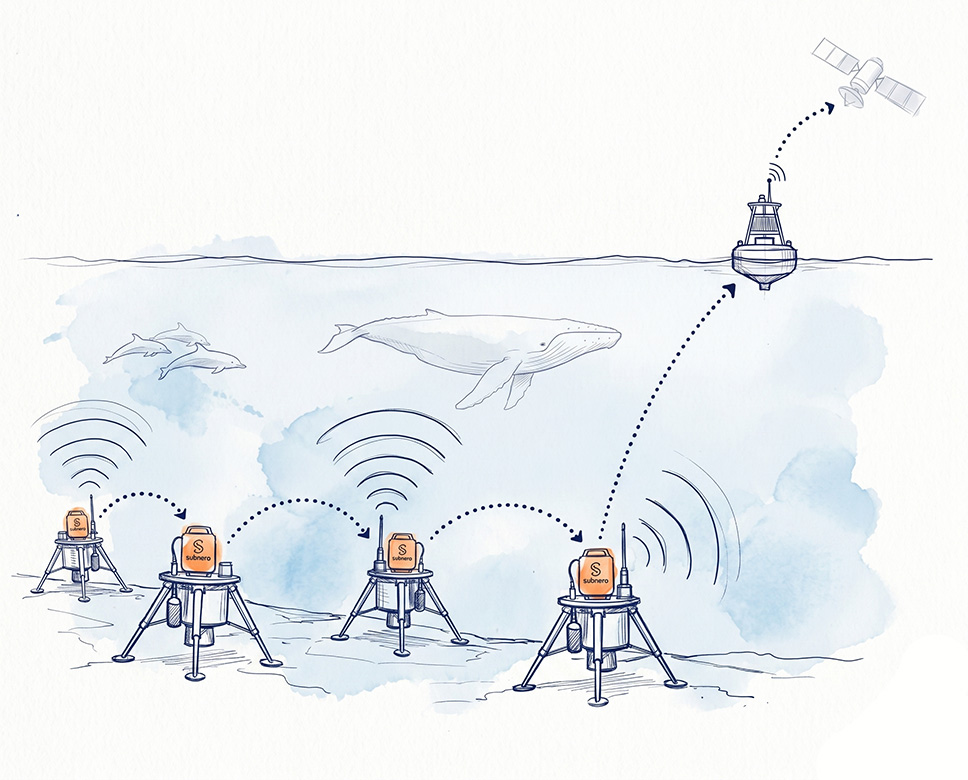
Hydrophone equipped seabed nodes detect whales, dolphins and other marine mammals and relay detections to shore in near real-time, with no recovery trips and no waiting for the data.
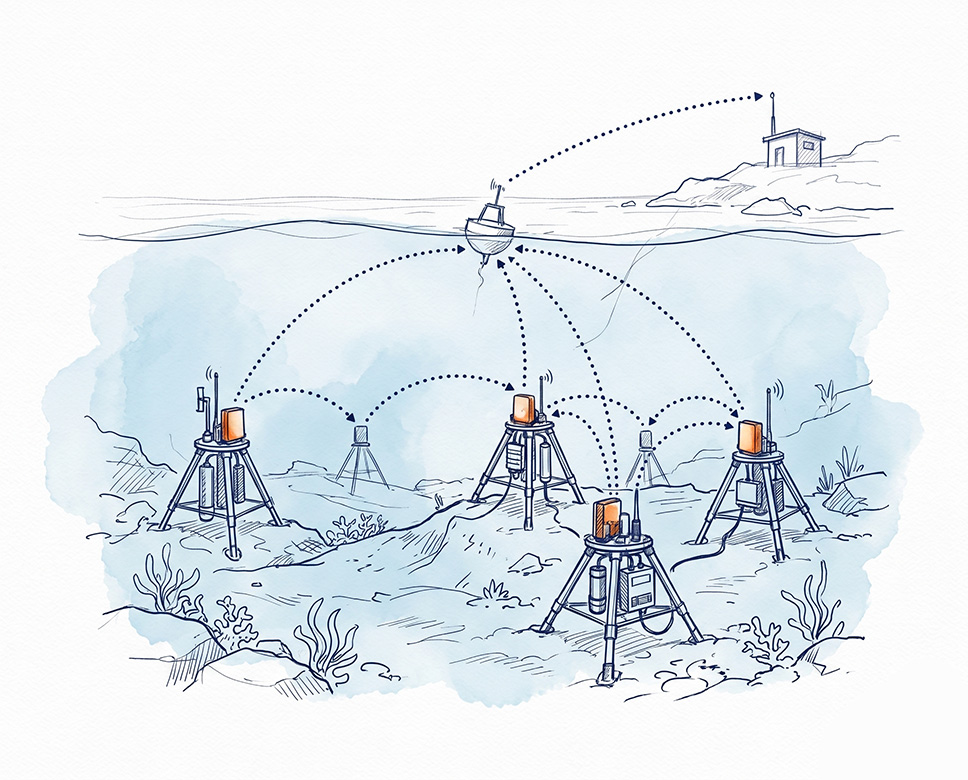
03. Ocean Observatories and Environmental Monitoring
Long term seabed stations and early warning sensors relay their data hop-by-hop to shore, season after season.
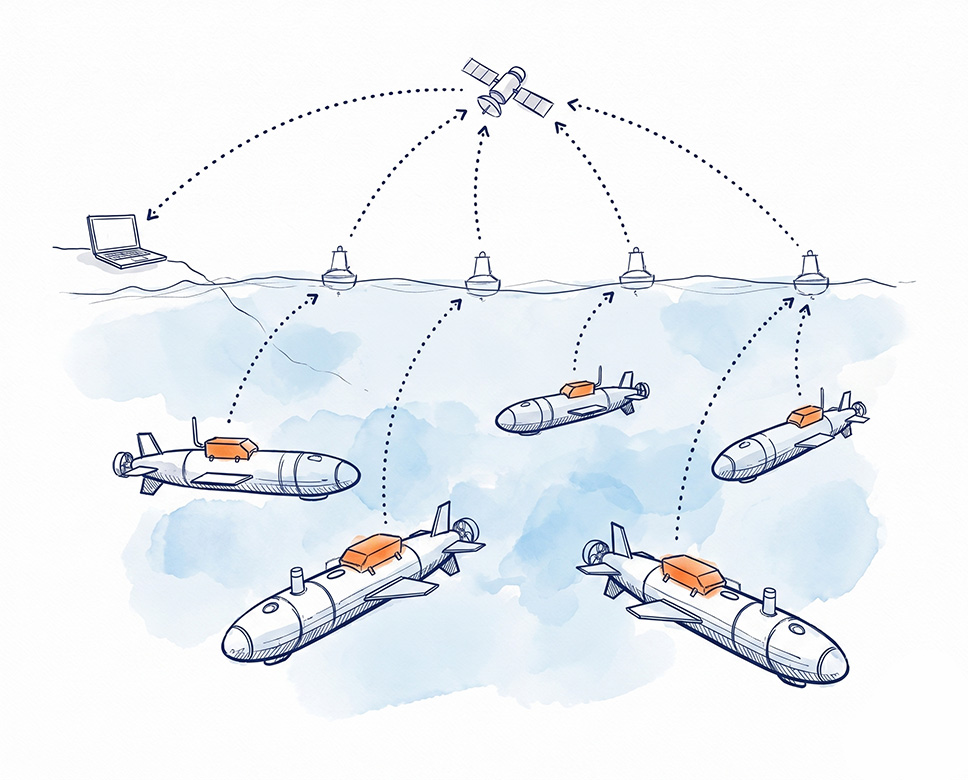
04. Marine Robotics Fleet Operations
Command, control, telemetry, and data offload for AUV and ROV fleets, with seamless handover as vehicles move across the survey area.
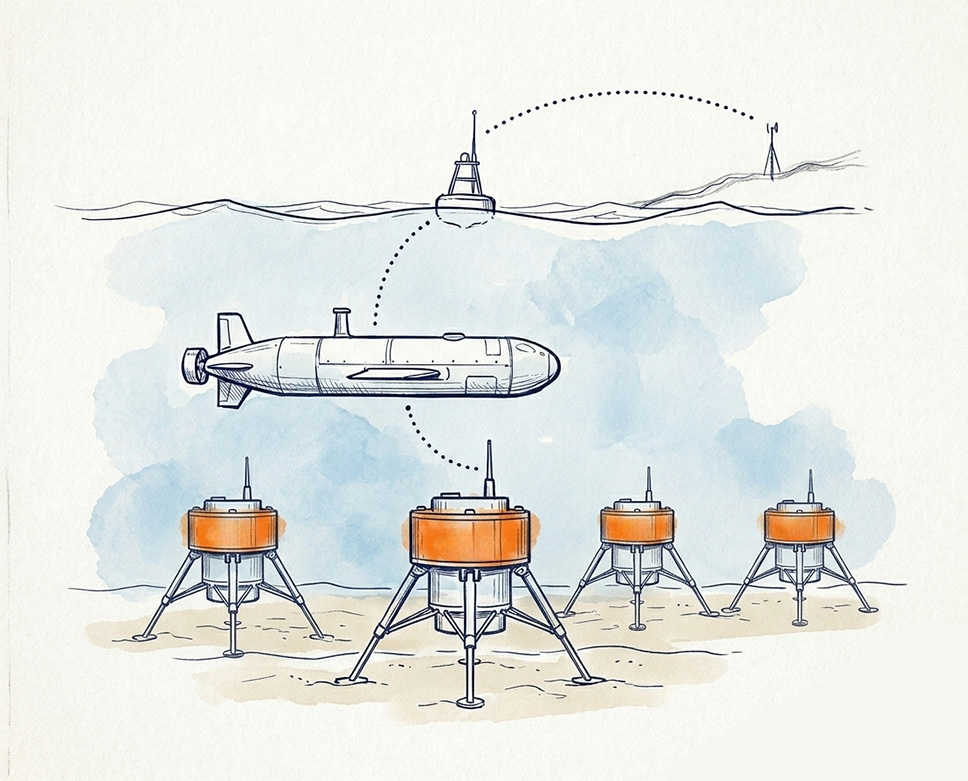
05. Data Muling
A mobile node or vehicle joins the network, collects data from many sensor nodes in one pass, and relays it back to your endpoint over the same stack.
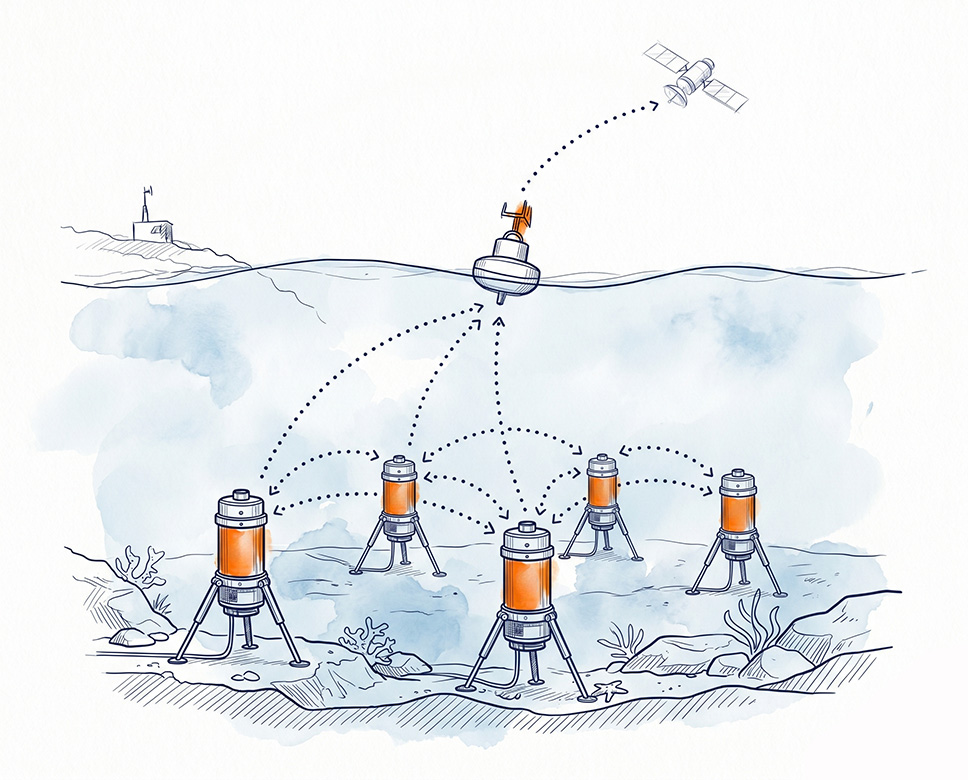
06. Persistent Subsea IoT
Many nodes, one always on network, from aquaculture farms to harbor infrastructure, scaling like a terrestrial communication layer.
Defense Applications
The same network underpins mine countermeasures, passive acoustic monitoring for surveillance, diver operations, and command and control. Explore the defense versions of these missions on our Defense page.
A Ready Network Stack for Your Most Demanding Missions
The Build It Yourself Path
Buy modems, then spend years building the network logic on top, a multi-year research program before the first real mission.
The SUN Path
Much of the hardest work in underwater networking is already built, field-tested and configurable. Your team configures the network for its mission instead of inventing it from scratch.
Multiple Topologies, One Stack
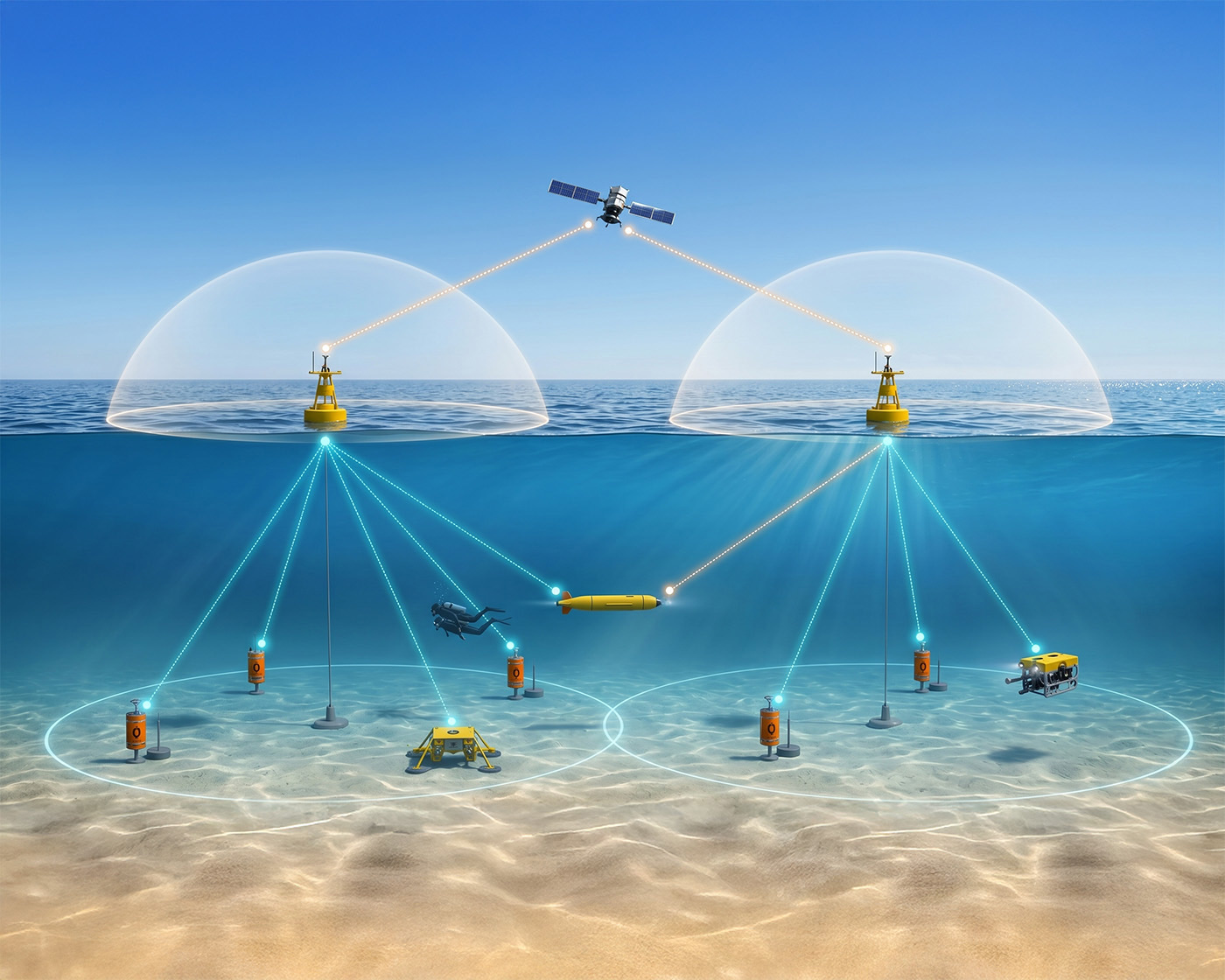
Centralized, Cellular Style
Centralized deployments can support coordinated coverage across operating areas, including mobile assets and multiple users.
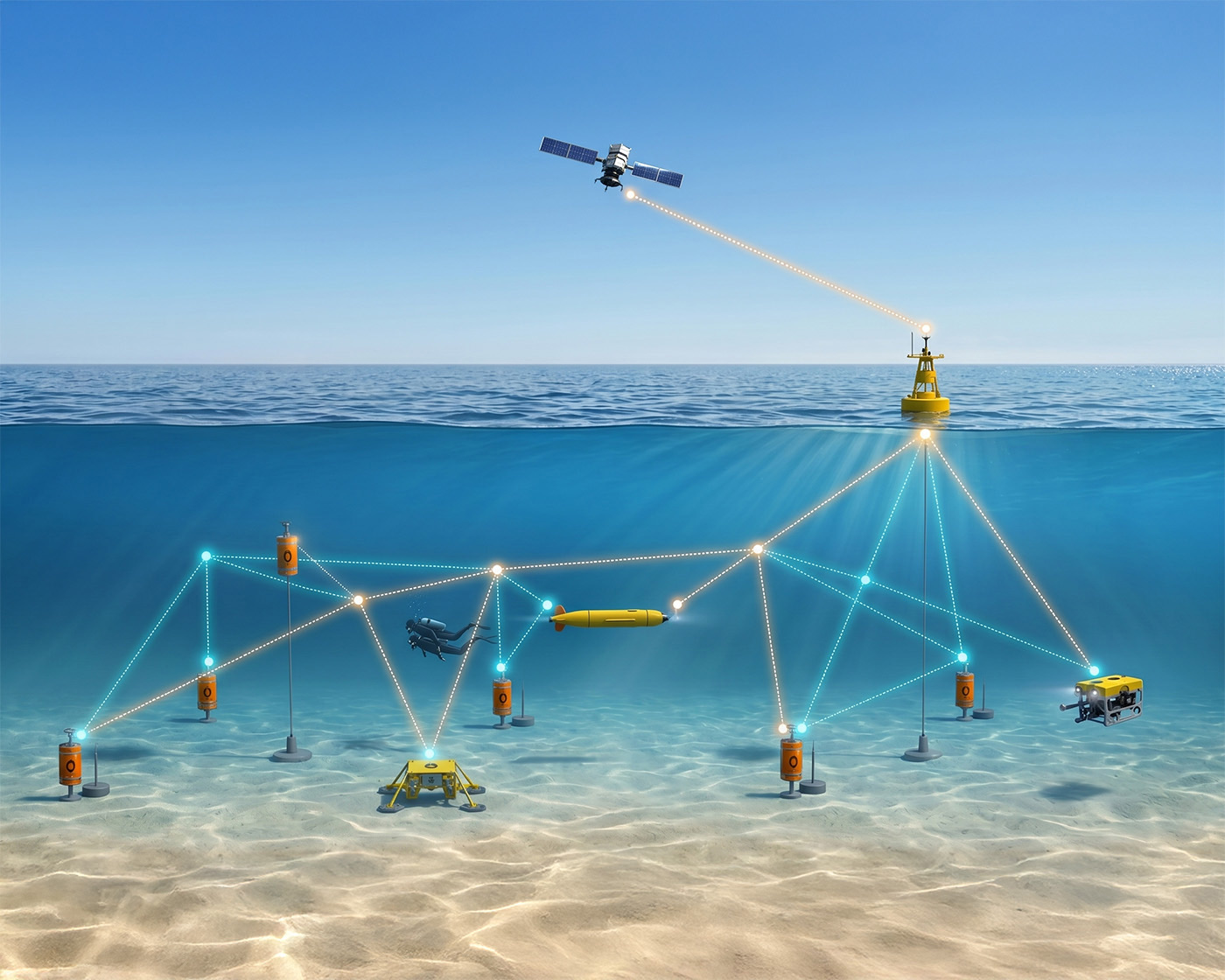
Ad Hoc Mesh
Distributed deployments can extend coverage across nodes when direct communication is not available.
Design, Simulate, Deploy
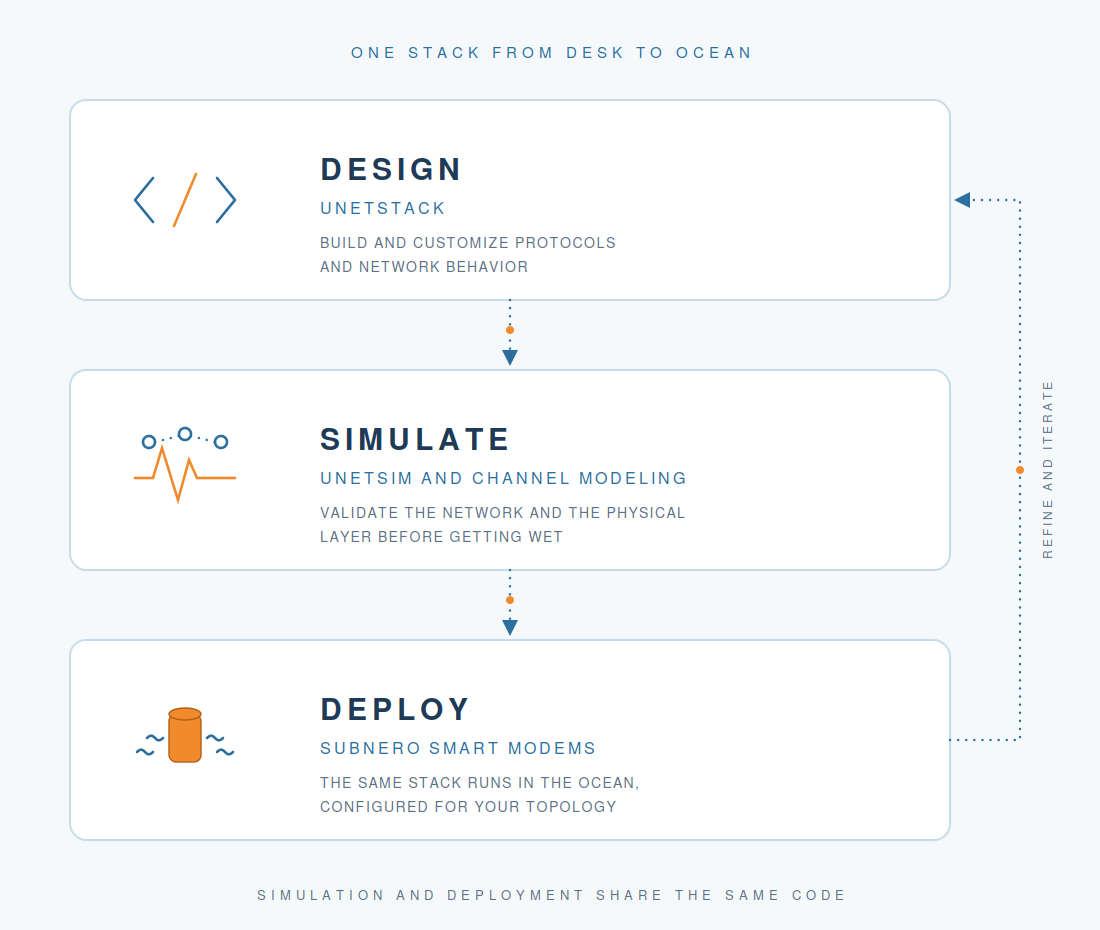
Underwater networks are hard to design and harder to validate before you get wet. Subnero gives you the complete toolchain to design, simulate, and validate the whole network on your desk before any node enters the water.
Design, simulate, and validate end to end, then deploy the same stack. Simulation and deployment share the same code, so what works on your desk is what runs in the ocean.
Proven in the Field
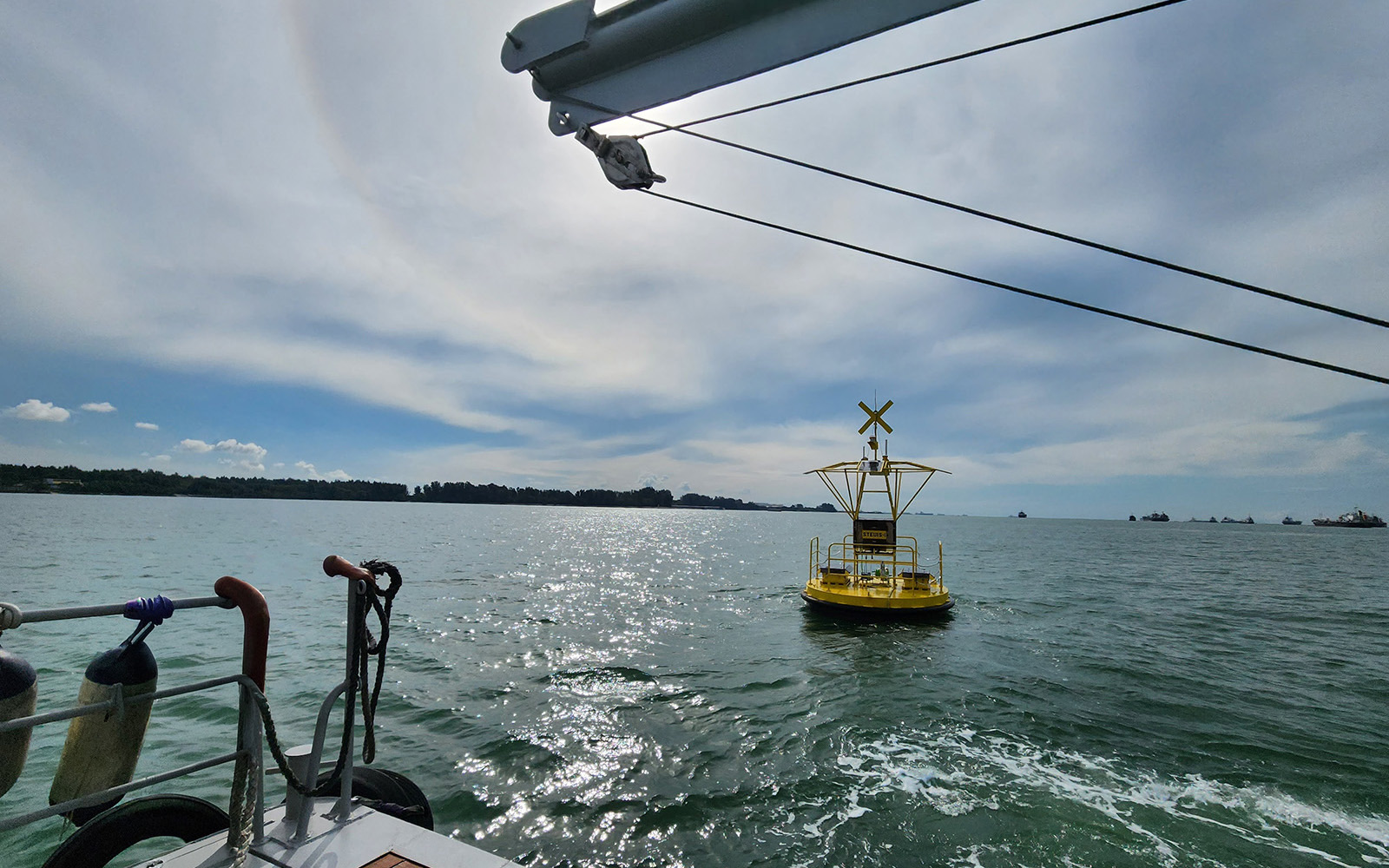
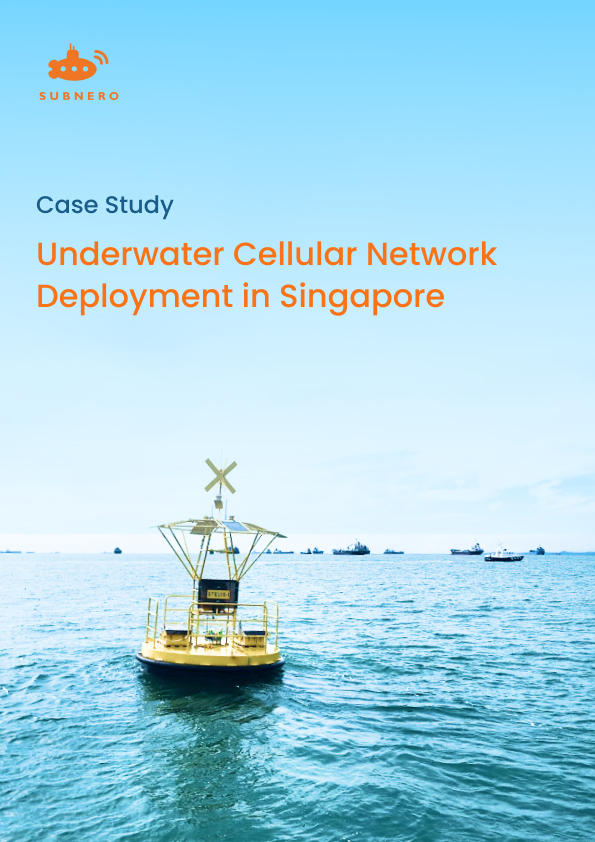
Subnero deployed one of the world's first commercial underwater cellular networks in Singapore waters, demonstrating continuous coverage, seamless handover, multi-user resource sharing, and real-time tracking of subsea assets.
The deployment is documented in an OCEANS 2024 paper and a full case study, and the same technology is deployed with customers around the world.
Download

Technical Whitepaper
The Future of Underwater Wireless
The technology behind underwater networks, from the physical layer to full network deployments.
Case Study
A Connected Ocean
How Subnero's Singapore deployment proved a multi-cell underwater cellular network with seamless handover and real time tracking.
Case Study
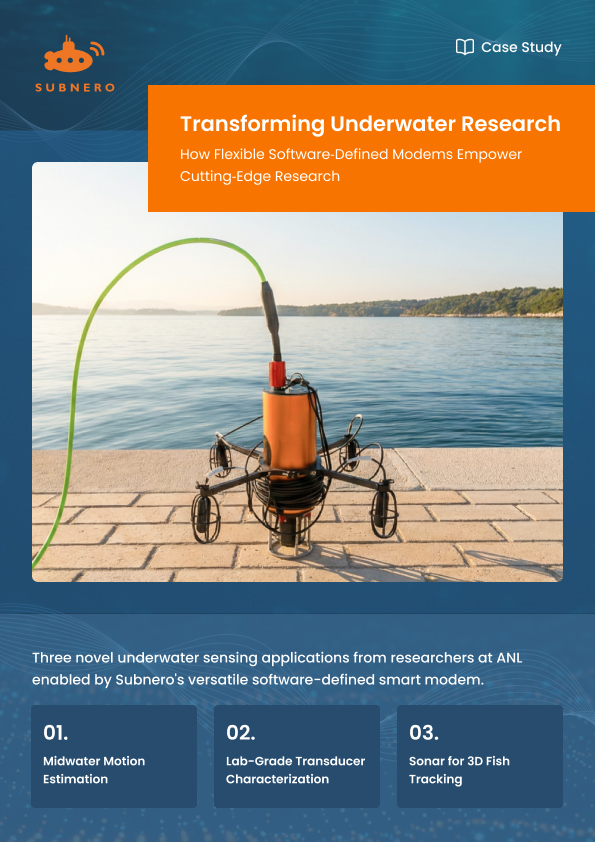
Transforming Underwater Research
How researchers used Subnero's software-defined modems for passive acoustic monitoring of marine mammals, alongside other advanced underwater sensing applications.