Customer Success Story
Smart Modems, Smarter AUVs
How the muNet Laboratory at the University of Alabama turned a commercial AUV into a programmable, acoustically controlled platform using a Subnero smart modem and UnetStack.
Overview
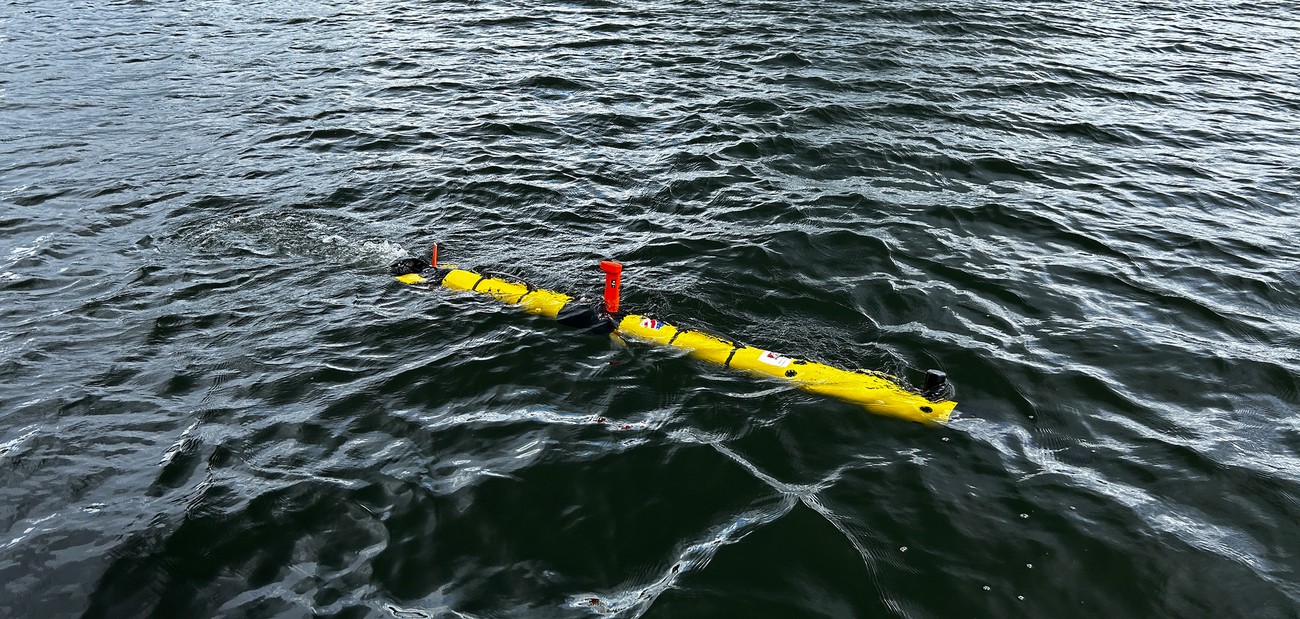
The muNet Laboratory at the University of Alabama turned a commercial off-the-shelf AUV into a programmable, acoustically controlled platform, putting a human back in the loop with a vehicle that is already submerged.
By integrating Subnero smart modems with L3Harris Iver3 EcoMapper AUVs, operators can observe what the AUV is doing, re-task it, and pull data on demand, all while it stays in the water. The starting point was a familiar constraint: a commercial AUV runs preset missions through proprietary software, and once it dives it is out of reach, which makes adding flexible acoustic communication and command and control (C2) hard.
Using the software-defined design of the Subnero modem and the UnetStack framework, the team built a robust mobile acoustic platform, focused initially on two things: acoustic waveform transmissions, and real-time communication and control. Just as important, the modem is not a transparent pipe: its onboard computing interprets commands from the surface, processes data from the vehicle, and decides what to transmit and when.
Problem
Proprietary software and hardware create a closed system that limits real-time control and access to the vehicle while a mission is underway.
Solution
The team installed a Subnero embedded configuration modem in the AUV payload section and bridged it to the vehicle autonomy stack.
Result
Operators can change missions while the AUV is submerged, query sensors on demand, and use the vehicle as a mobile acoustic testbed.
The Challenge: A Closed Architecture
A typical commercial AUV is engineered to run pre-planned missions reliably, not to be re-tasked mid-dive. That reliability comes from a closed control loop the operator cannot reach into.
The Closed Architecture
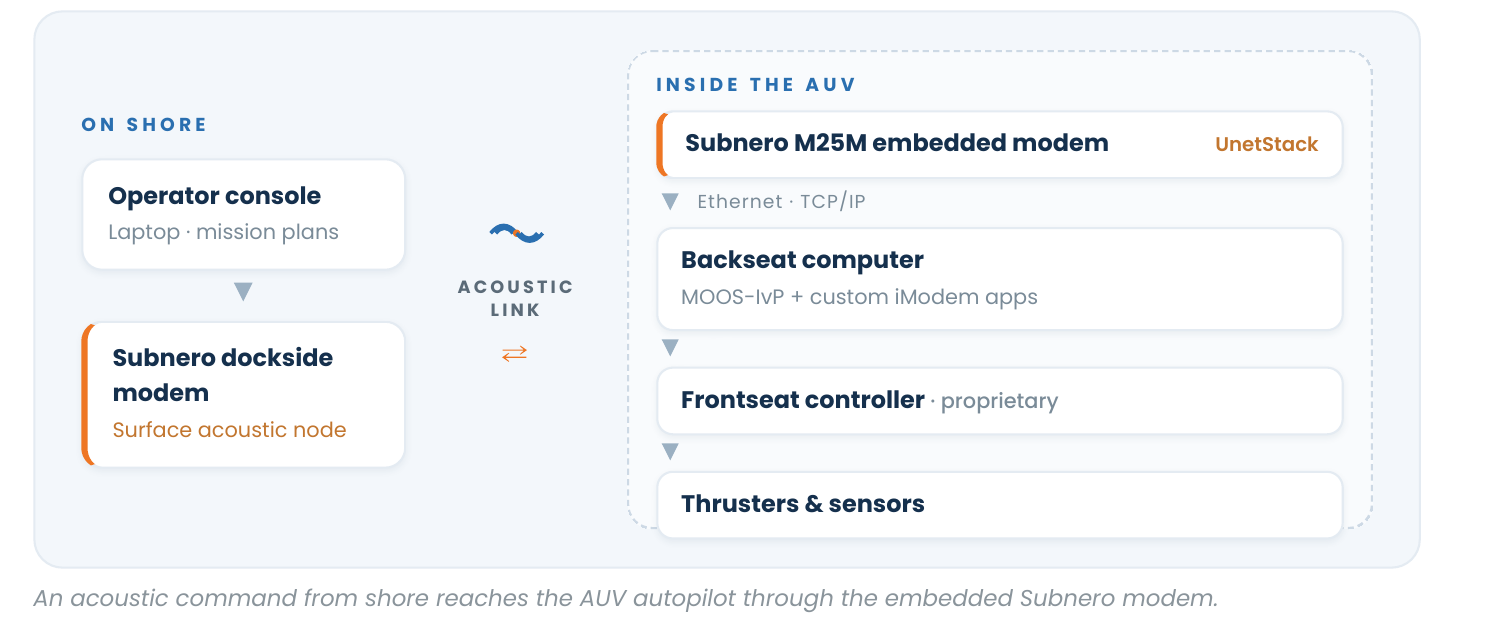
A commercial AUV runs preset missions reliably. The Iver3 uses two computers: a frontseat that runs the proprietary control software, and a backseat that is open to the user and can run custom autonomy on board. The backseat already lets a team shape how the vehicle behaves.
The Gap
What the architecture does not provide is a human-in-the-loop once the vehicle submerges. Radio and other links do not reach underwater, so a working AUV is cut off from its operator: no one can see what it is doing, confirm a result, or change the plan while the mission runs. The gap is the missing link that lets a person observe the autonomy provided by the backseat driver and redirect the vehicle in real-time, and a reliable acoustic connection between the surface and the onboard backseat is what closes it.
The Core Limitation
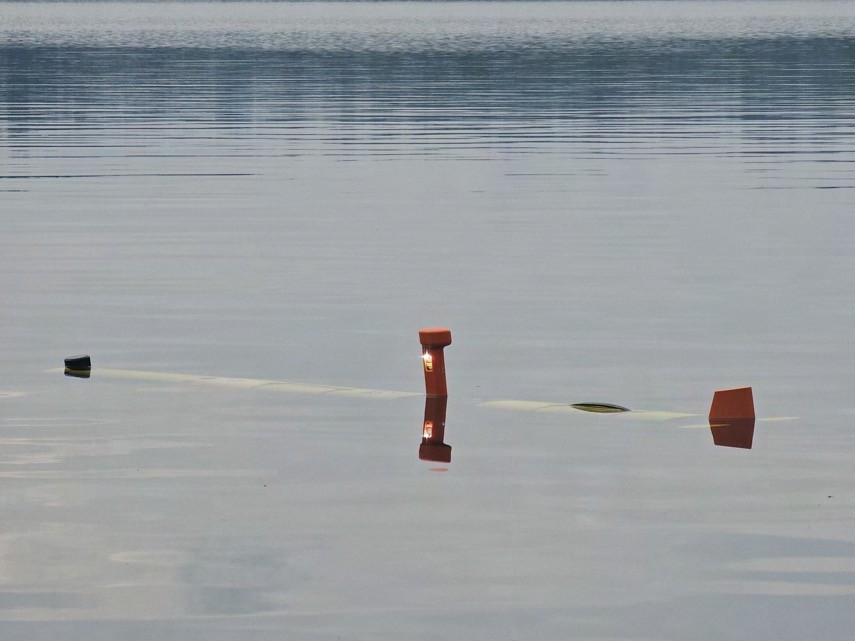
A submerged vehicle following a fixed plan cannot be re-tasked, queried, or corrected without recovery, costing time, flexibility, and opportunity.
The Solution: A Software-Defined Bridge
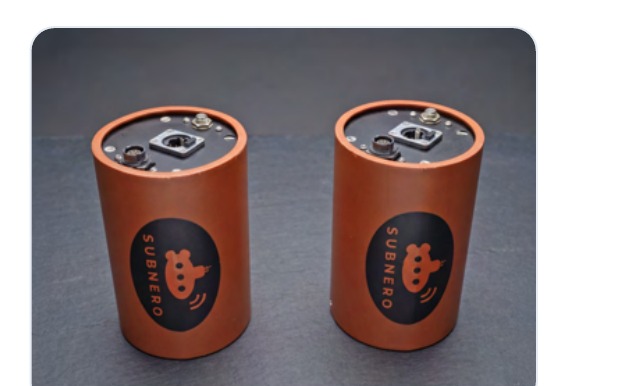
The team installed the Subnero embedded configuration smart modem in the payload section and connected it to the backseat computer over Ethernet, bridging the communications gap. A transducer was mounted on the hull.
Key Components
-
Subnero M25M embedded modem.
A software-defined acoustic smart modem with onboard edge compute and an open architecture API over TCP/IP, running UnetStack. It also runs onboard scripts that process and manage messages in both directions rather than just relaying them. -
Backseat computer.
Runs MOOS-IvP autonomy software together with the iOceanServerComms application, which relays commands to the proprietary frontseat controller. -
Custom MOOS applications.
Purpose-built translators between acoustic messages and the vehicle autopilot: iModemDeploy for mission control, iModemInfo for sensor queries, and iModemComms for intelligent scheduling of transmissions.
More Than a Pipe: Edge Intelligence on the Modem
What sets this integration apart is that the Subnero modem did far more than carry simple messages. Because it has onboard edge compute and runs user scripts, it acted as a smart node rather than a transparent pipe.
Inbound · Surface → Vehicle
Using its onboard edge intelligence, the modem interprets commands from the surface on board. For example, a depth request is answered by the modem itself, and a mission-switch command is converted into the exact instruction the autopilot expects.
Outbound · Vehicle → Surface
Through the same edge processing, the modem decides what to transmit and when. It keeps a depth-gated transmit at full power only when the vehicle is deep enough to protect the transducer, and it can run the team's own scripts to cancel unsafe transmissions and log every event for later analysis.
What This Unlocked
Take Over a Live Mission
Switch the AUV from its preset path to a new survey pattern in the water, then hand control back to the frontseat automatically.
Query the Vehicle on Demand
Pull live sensor values such as depth from a submerged vehicle without recovering it.
Schedule Transmissions Intelligently
Run custom logic on the modem so waveforms transmit only when the vehicle is below a set depth, protecting hardware from out-of-water transmissions.
Turn the AUV Into a Testbed
Use the moving vehicle as an acoustic source to collect channel measurements for the wider research community.
Toward Underwater Networks
That onboard intelligence, together with the full UnetStack network stack running on the modem, also opens the path to operations across multiple AUVs coordinating over a shared underwater network instead of a single point-to-point link.
Field Validation: From Testbed to Proof of Control
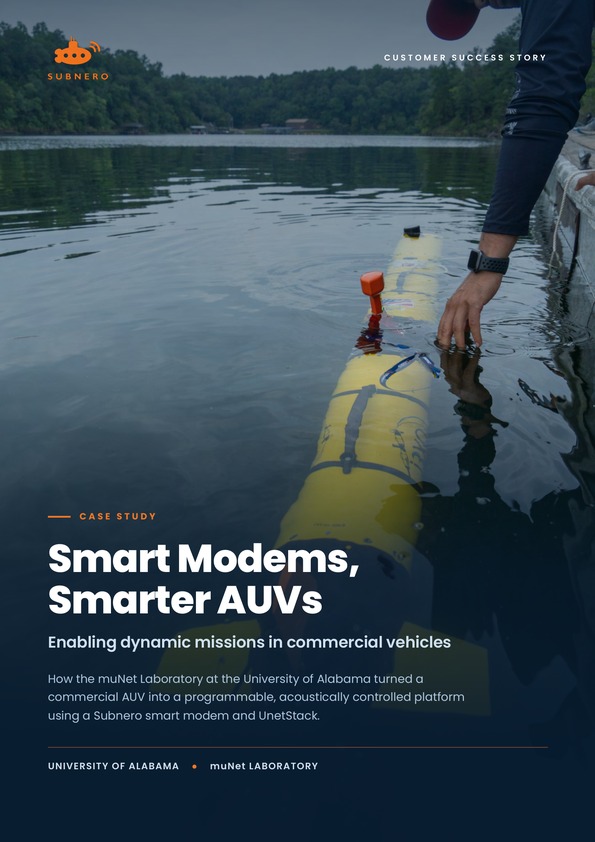
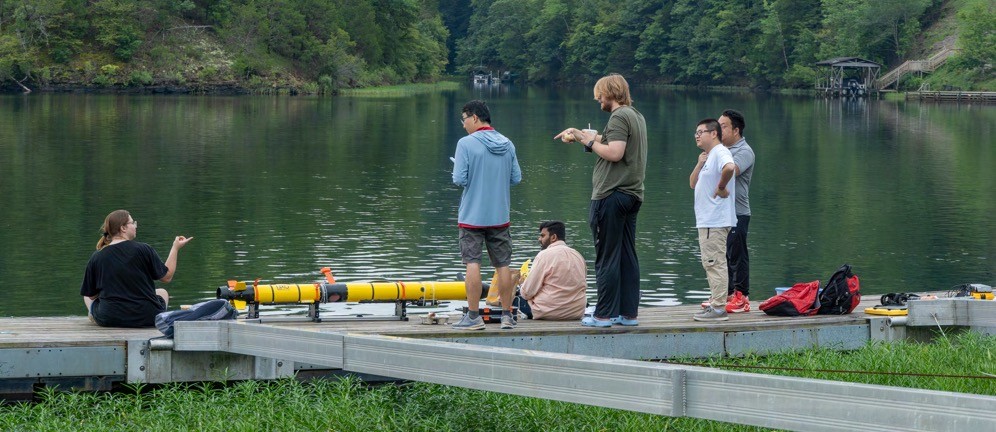
Field trials took place at Lake Tuscaloosa, Alabama, in roughly 20 m of water. Two integrated AUVs working alongside surface modems and a wideband hydrophone array.
Testbed Assets
Two L3Harris Iver3 EcoMapper AUVs, each fitted with a Subnero modem and a hydrophone array, plus two standalone Subnero modems.
Surface Equipment
A dockside Subnero modem on a laptop, and an eight-element wideband hydrophone array deployed from an anchored boat.
Results
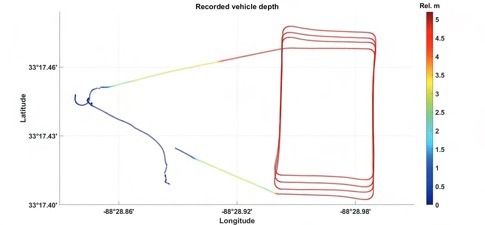
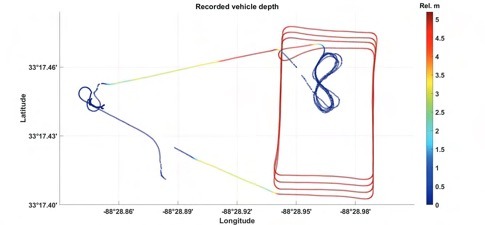
Recorded AUV tracks (colored by depth) before and after an acoustic mission-switch command. The inserted survey loop on the right confirms the submerged vehicle was re-tasked mid-dive over the acoustic link. Vehicle-track plots reproduced from Webb et al., WUWNet '22; data courtesy of the muNet Laboratory, University of Alabama.
- Seamless switching: A command over the acoustic link overrode the default frontseat path and started a new waypoint survey, confirmed by the recorded vehicle track.
- Real-time telemetry: Depth queries returned live readings from the submerged vehicle on demand, with no recovery required.
- Rapid integration: The open UnetStack API cut development time, letting the team build and field the applications quickly.
- Mobile measurements: The moving AUV transmitted waveforms around an anchored boat; the environmental, navigational, and acoustic data were collected and shared with external research groups.
Conclusion: Transforming AUVs
This case study shows that Subnero software-defined smart modems can turn AUVs with suitable payload space, power, and software interfaces into intelligent, connected assets. The integration with MOOS-IvP proves that Subnero modems support complex, adaptable autonomy, letting the team modify vehicle behavior while a mission runs, retrieve critical data without recovery, and build flexible mobile testbeds for acoustic research.
Looking Ahead
- Multihop networks. A multihop architecture is in development to communicate across multiple AUVs using an underwater network.
- New algorithms. Ongoing work includes OFDM communications research with the University of Utah.
- Open water. The team plans to deploy the testbed with Subnero modems in the Gulf in spring 2026.
About the muNet Laboratory
The muNet Laboratory at the University of Alabama conducts research at the intersection of ocean acoustics, wireless communications, and underwater robotics. Its students work across instrumentation, field deployments, algorithm design, and hardware prototyping.
Current focus: integrating acoustic communications into AUVs, with collaborators including the University of Utah, the University of Notre Dame, and Lehigh University.
About Subnero
Subnero develops underwater communication and networking technologies that aim to make underwater connectivity as seamless and scalable as connectivity on land, advancing the Internet of the Oceans. Through its acoustic smart modem platform and network intelligence systems, Subnero serves defense, marine, subsea, offshore energy, and scientific research sectors worldwide. subnero.com
Image Credits
All photographs and field figures courtesy of the muNet Laboratory, University of Alabama. Recorded vehicle-track plots reproduced from Webb et al., WUWNet '22.
Perspectives
Reliable AUV operations require more than rigid hardware; they demand flexible, intelligent communication. We chose Subnero because their software-defined architecture grants us complete control, allowing us to customize the acoustic link to meet the dynamic needs of our autonomous missions.
Dr. Aijun Song
Principal Investigator, muNet Laboratory
University of Alabama

The flexibility and openness of the Subnero modem's architecture has allowed us to develop a robust and fully automated mission planning pipeline. We can define our mission plans in config files and let scripts that talk to the modems do the heavy lifting.
Brodie Alexander
muNet Laboratory, University of Alabama